Ultrafast transient absorption spectroscopy is used to investigate electronic and nuclear rearrangement and energy redistribution in condensed phase chemical reactions involving electrocyclic ring-opening. Studies of well-defined simple systems permit connections to be drawn between the elegant advances that have been made in understanding reaction mechanisms in isolated molecules and reaction mechanisms in the "real world" of condensed phase environments.
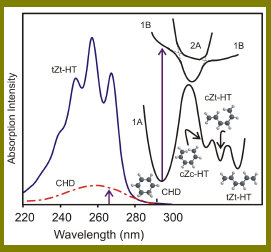
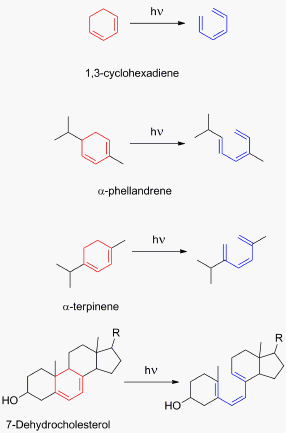
Work in our group has emphasized studies of the photochemical ring-opening reaction producing hexatrienes from the cyclohexadiene chromophore. UV excitation results in subpicosecond to picosecond ground state recovery and subsequent vibrational relaxation.
Studies include cyclohexadiene and natural products incorporating the cyclohexadiene chromophore.
Both a-phellandrene and a-terpinene are natural products used in the food and cosmetics industries. Both undergo ultrafast ring-opening reactions analogous to cyclohexadiene.
7-Dehydrocholesterol (DHC) is also known as provitamin D3. This molecule undergoes photoinitiated ring-opening and thermal hydrogen transfer and electronic rearrangement to form vitamin D3. Our studies focus on DHC and two analogs, the naturally occurring ergosterol or provitamin D2, with modifications in the tail "R", and DHC-acetate, with the OH replaced by an acetate group.
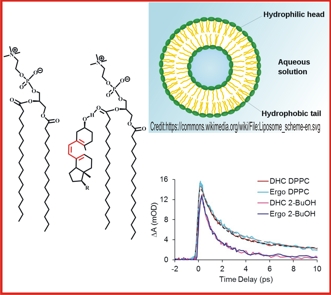
DHC and analogs are studied in solution and in liposomes to mimic the natural skin cell membrane environment for the reaction. Incorporation into a liposome introduces a slow component to the excited state reaction.
This research is supported by the National Science Foundation