Superheroines and
Media Crossover
If you have had a chance to read through most of our site, then you already know that the characters discussed on these pages were selected because they had crossed over from one medium to at least one other medium. Our three choices of media are comic books, television, and film. The ability to cross over from one medium is not an ability to be ignored.
This essay makes an attempt at explaining what determines the crossover of a character. In addition, this essay addresses some differences between storyline and details that sometimes occur when a character crosses over to another medium.
For most of this discussion the female characters from the X-Men will be used. The reason for this is threefold. First, the X-Men comic book series has been the most popular to date. Secondly, the X-Men have successfully crossed over to all three media. Thirdly, there is one character that crossed over to television, but not to film. This makes her ideal comparison to the others who did cross over to film. Four female X-Men characters have been included on our site: Phoenix (also known as Dr. Jean Grey-Summers), Storm, Rogue, and Jubilee.
Comics
|
|
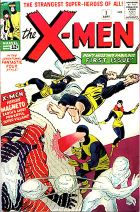
The first of these characters is Phoenix who, for the purposes of this essay, will be referred to as Jean Grey (maiden name). Jean Grey appeared in the first X-Men comic book issue. X-Men #1 appeared in September 1963, and Jean Grey has been part of the X-Men saga ever since. In the first issue, Jean Grey first joined the X-Men under the name of Marvel Girl. Her major powers were telepathic, but she also possessed limited telekinetic abilities.
When Stan Lee (writer/creator) and Jack Kirby (artist) first introduced the X-Men it was not received as well as Lee's other creations, which include Spider-Man (Daniels; Foege). Nevertheless, Marvel Comics did not give up on the series. Instead of being cancelled, reprints of old issues were released in 1970, and in 1975 the X-Men team that we are most familiar with today was introduced. This was the major turning point for the future of the X-Men, including Jean Grey, and it marked the introduction of the second major female character of the X-Men (Daniels 141+167).
The
second female member to join the X-Men was Storm. She first appeared in Giant Sized X-Men #1 in 1975.Storm possessed the power to manipulate the weather.
|
|
|
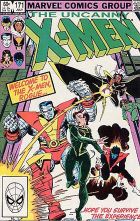
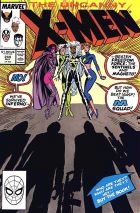
The next female addition to the X-Men was Rogue. Rogue first appeared in the Avengers Annual #10 in 1981, but initially she joined with the evil mutants. It was not until Uncanny X-Men #171 in 1983 that Rogue joined the X-Men. Rogue had the ability to absorb the energy, powers, and memory of others through physical contact. However, by the time she joined the X-Men she could also fly, possessed super power strength, and could be considered invincible. These extra powers she gained through a permanent absorption of the powers of Ms. Marvel while Rogue was still affiliated with the evil mutants.
The last female superheroine from the X-Men included on these pages is Jubilee. Jubilee first appeared in Uncanny X-Men #244 in 1989. Jubilee can create balls of energy, and she can direct these energy spheres in any way.
Television
|
The Logo for X-Men:The Animated series (1992-1998). Picture from Pazsaz Entertainment Network page. |
Each of these ladies crossed over into the television medium. They were all featured characters on X-Men:The Animated Series (1992-1998). Although the last of the new episodes of the animated series aired in 1997, the cartoon has gone into syndication and was shown on the FOX network in more recent years, probably partly in preparation for the then upcoming movie. Jean Grey, Storm, Rogue, and Jubilee all appeared in the very first episode.Jean Grey, Storm, and Rogue by this time had become important characters in the comic book series, and, at least in the case of Jean Grey and Storm, they were long lived. Even Rogue had been with the X-Men for almost ten years. Jubilee, however, was relatively new to the bunch, and this may explain her inclusion in the cartoon. Jubilee was someone new to the group and a nice way to bring the X-Men into the next decade and the television medium. Jubilee was also uses as a tool for plots and tension between the evil mutants and the X-Men. This role of Jubilee is apparent in the very first episode where she is kidnapped and the X-Men have to save her. The cartoon, in fact, begins with the introduction of Jubilee to the X-Men. The first episode is based on Jubilee's first encounter with the X-Men.
Movie
X-Men the Movie was released just this summer (2000). It included our female superheroines Jean Grey, Storm, and Rogue, but not Jubilee. The movie instead begins when Rogue first joins the team of the X-Men.
Differences in the Three Media
From Comic Book to Television
The cartoon version of the X-Men did make an attempt at staying true to the story lines and themes of the comic book to some extent, but there are some differences. For instance, in the first episode, Night of the Sentinels, Jubilee has been living with a foster family and went to the mall, where she was rescued by the X-Men, only to get away from her foster parents briefly. In the comic book, Jubilee first ran away from an orphanage and made a home at the mall. She stole what she needed to live, and on one of numerous chases from mall security she was cornered by mutant hunters and rescued by the X-Men.
In the same episode of the cartoon Jubilee is taken (she was unconscious) by the X-Men straight to Professor Xavier's School for Gifted Youngsters. Whereas in the comic book, she followed the group through a portal at the mall after her rescue to their base of operation. Once through the portal, Jubilee lived in a tunnel where she watched the X-Men and gathered food and clothing from them while they were elsewhere.
It is unclear why these changes were made, but it is possible that including them would have just made the whole experience more complicated. Including Jubilee's past life as a delinquent living in Juvenile home who was sent to an orphanage and ran away to a mall where she was rescued from capture by the X-Men is probably not as exciting to the viewer, at least on television, as seeing her instead being captured by sentinels and being saved a second time by the X-Men.
Showing all of the events of Jubilee's life accurately before she met the X-Men would have also taken precious time away from the more exciting and promising themes of the cartoon, which was only a half and hour once a week. In a sense, the writers of the cartoon determined what small tidbits were important to the history of the X-Men and what was not. They in turn eliminated that which they thought was the least important and worked from there. Still, the attempt at staying close to the comic book storylines is remarkable when it comes to stories like Rogue's past and the Pheonix Saga. Thus, there was not complete abandonment of the comic book ideas. Differences were relatively subtle.
From Television to Film
It is not clear how the transition to film should be viewed. Technically it is based on the comic book series, but because it followed the animated series in media progression it might be useful to examine between the two.
The most obvious difference from television to film is the starting point. While the animated series starts at Jubilee's entrance to the academy, the movie goes much further back to the entrance of Rogue to the team. Thus, Jubilee does not appear in the movie at all. In the movie, Rogue first discovers her powers, runs away, and ends up being rescued by members of the X-Men. By the end of the movie, she is a resident at the academy. In the cartoon Rogue's past is visited once in the the episode "A Rogue's Tale," and it is clear that before Rogue became an X-Men she found refuge with the evil mutants and even came to be regarded as a daughter to Mystique, one of our supervillainesses. This difference is not as subtle as maybe Jubilee's living with a foster family or at an orphanage might be, but it was still left out of the movie.
The story of Rogue's past can be a movie in and of itself. On the cartoon it warranted an entire episode. So then, it may be safe to assume that the movie makers had to set some limits to what they could do in two hours, the average running time of today's movies. It is notable that Wolverine was also added to the group at the same time as Rogue in the movie. Thus, it was not her story alone, and this limited the time and amount of the movie that could be allotted to her personal history.
From Comic Book to Film
The same differences can be found between the comic book and the film. In the movie, Rogue's past with the evil mutants is eliminated, at least for the time being. Additionally, in the comic book Rogue's identity is unrevealed.
Although, the story of kissing the young boy, causing him to lose consciousness, and the initial realization of her powers is present in some form in all three of the media, other aspects of Rogue's life remain a mystery. This mystery includes such simple information as Rogue's real name.
Nevertheless, one difference in the the movie that would be caught by die hard X-Men fans, but possibly missed by others, was the fact that Rogue was given a name in the movie, however generic the name may have been. In the beginning of the movie Rogue is called "Marie" by her parents.
Later on in the movie, while in Wolverine's truck, Rogue tells him her real name. Why this bit of information was fabricated by the movie makers is unclear. Perhaps they wanted to add depth to Rogue's character or knock off a small amount of the mystery behind her. Still, giving Rogue a real name did not seem to have great bearing on the story, and script writers and movie makers could have probably gotten away without giving her a name. For instance, her parents could have just called her "Honey" or "Dear," and a part of her initial resistance to Wolverine and others could have actually been played up more if she had instead refused to tell Wolverine her real name. Nevertheless, she was given a name in the movie perhaps for the reasons mentioned previously. These are just a few apparent differences between the comic book and the movie.
What Determines Whether or Not a
Character Will Cross Over?
With the case of the X-Men in general, not just for our female characters, the key seems to be popularity and staying power. The Giant Size X-Men comic book series was the most popular of its time, and the X-Men series continues to be the most popular currently (Daniels 167). Some of the more recent success of the comic book team is apparent in the following quote from an article by Alec Foege:
By the early nineties, the flagship X-Men comic was circulating roughly 500,000 copies a month, a second series with the same characters--among them Cyclops, Storm, and the phenomenally popular Wolverine--sold 7.6 million copies of its first issue, and both series and their various spin-offs represented 20 percent of comic sales in the United States. (54)
Ever since the new team of X-Men was introduced in 1975 the popularity of the comic has soared. New issues are still released today and there are several spin-off comics resulting from the first two X-men comics. It is this kind of staying power that has some kind of say in whether or not a comic book character will cross over.
The female X-Men that crossed over can in a sense be thought of as simply reaping the benefits of being part of the popular team. When the animated series first aired Jean Grey, Storm, and Rogue were logically included, and they were included in the movie. Still, it is likely that if the characters were not a part of this team, but still exhibited the same type of staying power as the X-Men team, they would have still crossed over into some other medium.
Probably one of the best examples of a superheroine who achieved this crossover status without having such a distinct team affiliation is Wonder Woman. Wonder Woman first appeared in 1941-42 and has appeared in comics ever since. It is this staying power and her popularity that landed her a made for television movie in 1976 and a television series from 1975-1979.
Furthermore, it is important to note that not only were Jean Grey, Storm, and Rogue part of the popular X-Men team, but they were treated almost as equals to the males in the comic. In essence, all members were treated as essential to the team. Thus, the popularity of these female characters not only stemmed from them being part of the team, but from their own individual stories and adventures while a part of the team.
For instance, probably one of the most important and well known storylines of the X-Men is the Phoenix Saga. This saga is present in the comic book as well as the animated series. This saga tells the story of Jean Grey and her transformation to Phoenix. The set of the five corresponding animated series episodes has even been released on DVD. Jean Grey's main story line illustrates the importance of individual characters within the team. Staying power and popularity then are established for characters within the team, and this helps determine whether or not they will cross over into another medium.
The second way to cross over seems to be by hanging on to the bootstraps of another character, in most cases a super hero, rather than a superheroine. Some examples of such crossover in our list of superheroines are Catwoman, Batgirl, and Poison Ivy. Each of these characters crossovers has been dependent on Batman.
Although there was eventually a Catwoman comic book, her first appearance was in Batman #1. Her crossover to television was on the Batman show (she also appears in the Batman cartoon), and her crossover to movie was in Batman Returns (1992). Although, she has the stay power, she does not appear in every episode of the show or cartoon like the female X-Men do, and her role is ultimately tied in to that of Batman. In the realm of television and movie she has yet to exist without him.
The same is apparent for Batgirl and Poison Ivy. Batgirl also appeared in the Batman television show and cartoons. Her movie appearance was in Batman and Robin (1997). Poison Ivy has appeared in the cartoons and the movie Batman and Robin (1997). In each of the three cases, the characters appear only periodically and do not share the equality with Batman as the females of the X-Men share the equality with the male members of the team.
Some may argue that the females of the X-Men are not different than Catwoman, Batgirl, or Poison Ivy in that their crossover is dependent on the team. Nonetheless, it is important to stress that Jean Grey, Storm, and Rogue are treated as equals in the comic book and animated series. Each female appears in each issue and each episode. This is not the case for Catwoman, Batgirl, and Poison Ivy.
Thus, there are seemingly two ways to cross over from comic book to television and/or movie. First, the character has to have a reasonable level of stay power and popularity. Secondly, if the character's role is dependent on that of another more prominent character, then they may consequently crossover with that character.
So Why didn't Jubilee Crossover to Film?
First, it is important to say that it is not yet clear that Jubilee will not crossover to film. Simply because of the point in time that X-Men the movie began, there was no way to include Jubilee. There is talk of a second X-Men movie, and possibly even a third. The storyline for the second movie is yet to be determined, but some think it will either be based on the Phoenix Saga or somehow include the sentinels, evil mutant hunters (comics2film.com, cinescape.com).
If the second movie does involve the Phoenix Saga then once again it will not include Jubilee. She simply was not around at that time. However, if the sentinels are introduced in the next movie it would only make sense to include Jubilee since her entrance to the team was through an X-Men rescue from the sentinels. Nevertheless, any discussion of the sentinel theme lacks the mention of Jubilee.
Aside from the time frame of the movie, it may be the case that Jubilee does not have the fantastic popularity and stay power as the other female X-Men. Jean Grey, Storm, and Rogue all have integral stories for the comic series. Jean Grey and her Phoenix Saga, Rogue and her life with the evil mutants before joining the X-Men, and Storm who has been considered nurturer of the X-Men all have long running and unique histories that make them integral parts of the X-Men comic book legacy. Jubilee's story as it stands now is just as a helpless teen mutant being rescued from a mall by X-Men. Currently, there is no special story to place her in the ranks of the other female X-Men. This could be an important explanatory factor if Jubilee never makes it to the X-Men movies.
Lastly, as far as the comic book goes, Jubilee is no longer a member of the X-Men. She is a member of the Generation X. Generation X is basically the new generation of good mutants. They are another group founded by Professor Xavier, and the group consists of teenagers. Xavier asked Jubilee to join this group when he first founded it.
Although, she viewed the reassignment as a demotion, Jubilee eventually became comfortable with the group and became a team player. The fact that Jubilee is no longer a member of the X-Men and possibly that she is a teen may be one reason we may not see her in the X-Men movies. It was the initial portrayal of the X-Men as teens that is viewed as a reason they did not take off at their initial release in 1963 (Daniels113). By 1975, they were being portrayed as adults. Nevertheless, a teenage Rogue did make it into the movie, so the idea of Jubilee not being an X-Men may be a better explanation than one of her age.
Going "Backwards": From
Television and Film to Comic Books
The earliest of our superheroines appeared in comic books first, so it is reasonable to think of characters as crossing over from comic books to television and/or film. Although the X-Men, Catwoman, and Batgirl went from comic books to television to film, some of our characters did not start out in comic books.
The Bionic Woman started out as a character on the television show "The Six Million Dollar Man" (1974-1978). The popularity of "The Six Million Dollar Man," along with the popularity of her character on the show, gained the Bionic Woman her own show. During the run of "The Bionic Woman" (1976-1978), a comic book was also released for the Bionic Woman. The comic book was called "The 'All New' Bionic Woman," (1977-78). However, it was short lived and had only five issues. This may be because the steam was already running out of both "The Six Million Dollar Man" and "The Bionic Woman." The comic book was probably an attempt at banking on the popularity of "The Bionic Woman" and "The Six Million Dollar Man," but with the end of both shows and its probably lackluster success, it is understandable that the comic book was also cancelled.
More recently, two characters have crossed over from television and/or film to comic book. Buffy the Vampire Slayer started off in a movie that was released in theaters. The theme of the movie was then recycled and set to television with a new star. The show, "Buffy the Vampire Slayer" (1997-present) was well received and is still airing new episodes today. The popularity of the show, and the resurgence in popularity of comic books due to comic book sensations like the X-Men probably fueled the creation of a Buffy the Vampire Slayer comic book. Xena:Warrior Princess is also a character that crossed over from television to comic books.
In all three of these examples, the creation of a comic book appears to be an attempt to extend the popularity of the show to reach another audience and hopefully make more money. The success and popularity of the X-Men comic book series and its spin-offs may very well be the reason that creators of Buffy and Xena comic books saw hope for success when starting the two new comic book series.
Monetary Issues and Staying True to
the Original
The creation of Buffy and Xena comics brings up another point that has yet to be made in this essay. The crossover of a character is also determined by monetary decisions. If companies feel that a character can make money in a different medium, then that feeling may help to encourage character crossover. Nevertheless, the outcome of a crossover fueled as such is sometimes dependent on how true the new medium stays to the storylines of the original medium.
For example, Les Daniels discusses how Marvels first attempts at movies were not well received because they did not stay true to the comic book conceptualization of characters. Movies like the Punisher and Captain America betrayed the story of their comic book characters (216). The very fact that the X-Men animated series and the movie did, for the most part, make a conscious attempt at staying close to the storylines in the comic books may help explain their success.
Also, the amount of money allotted for a film may determine what storylines are included and how characters behave. The film X-Men the Movie was allotted only $75 million dollars, and though at lot was done with this amount, more could have been done with a greater amount. Would we have seen more characters? Would Rogue's past with the evil mutants have been included? Will a bigger budget for X-Men 2 bring on more characters and storylines? It is hard to give answers to any of these questions, but it is clear that the amount money allotted for a film or television show does to an extent dictate what will be included.
Going Back
Home--Crossing Back Over to the Original Medium
|
Prequel Cover from Movie Headlines site |
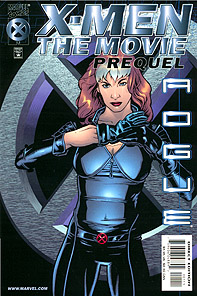
The crossover of the X-Men did not end with the creation of the X-Men movie. Shortly before the movie was released, Marvel Comics released a set of X-Men prequel comic books to the movie. These prequels are intended to explain certain characters before their appearance in the movie. There is an issue that features Rogue and attempts to explain her behavior in the movie. In this comic book, and in the tradition of the original comic and the cartoon, Rogue remains nameless despite the fact that she has a real name in the movie. The history of Rogue is also recreated in the prequel comic book to better coincide with the movie. Rogue does not have the same affiliation with the evil mutants before she meets and joins the X-Men in this comic. Instead, when the X-Men first come for her she runs away, and eventually is captured and taken to the mutant research facility where she is later rescued by the X-Men (movieheadlines.net, marvel.com/x-men/tiein_rogue.html).
Additionally,
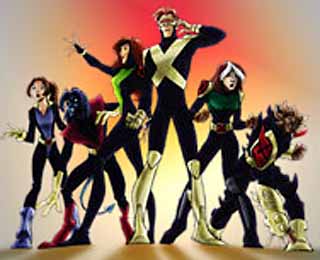
this fall another X-Men cartoon began. X-Men Evolution (2000) tells the story
of the now grown up X-Men in their teenage years. Of our superheroines, Jean
Grey, Storm,
and Rogue are included in this series. It is clear that Jubilee
once again was not included because she was not around when the others were
teenagers. The series began only weeks ago, so it is too early to tell how true
the stories will stay to the original the comic book series.
|
X-Men Evolution Cast. Picture from epguides.com |
Conclusion
The major points of this discussion are that it takes great popularity and stay power to warrant a crossover. The character also has to be able to provide a profit if released individually. If the character cannot stand alone, then the crossover may be a result of a dependence on a more popular character. When a character finally does cross over there may be differences in the storylines from one media to another. Part of this can be explained by the factor of time, part by the allotment of money, and part by the level of interest including one element of a history will bring to the show.